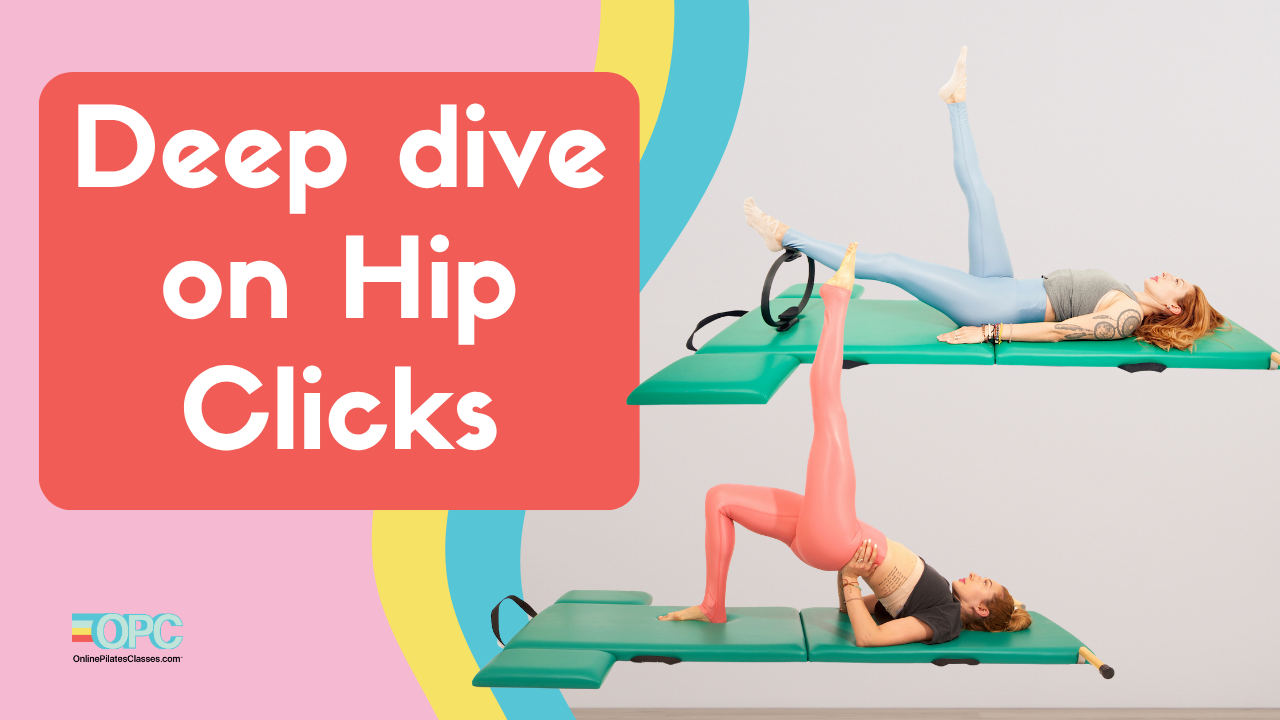

Improve Your Pilates Overhead Skills
Hey there. Are you struggling with overhead Pilates exercises? If so, you’re not alone, and it’s important that you know you’re probably not doing something wrong. In fact, there’s a few factors that you are probably experiencing that are keeping you from going overhead in your Pilates practice. So let’s get into it.
Welcome to Online Pilates Classes, the most supportive Pilates community worldwide. Enjoy new weekly classes from our incredible teachers. Download the OPC app today.
I’ve been doing Pilates since 2005, teaching since 2008 and the overhead exercises blew my mind. First of all, it was kind of a little weird that I could do them, because I have a hypermobile body, I could get into them, but they felt terrible in my body. Then I’d see people who were a little tighter when you do Pilates longer than me, and they were struggling too. And so it’s like, well, are these exercises just weird? What’s going on? How come I can get into it, but they feel awful? How come they can’t do it yet? What I came to realize is that a lot of times, we’re looking at the Pilates overhead exercises in the wrong way. We see advanced next to it, and we go, that must mean I need to do those because it’s harder. And yes, advanced exercises are harder, but we have to build up our ability to do them. And it’s not as fast as you think. And oftentimes, if you’re going to classes and studios, you might be rushed into these overhead exercises a little sooner than you’re ready. So let’s talk about the skill sets you need, what might be hindering you, and why it might take some of our bodies longer than others to get into these exercises.
Why Overhead Pilates Exercises Are Hard
Well, first, they require a strong, deep core muscular ability, not just the ab muscles, in fact, definitely not just those visible ab muscles, those can often hinder you from being able to do an overhead exercise. Second, you have to have a strong upper back, not just a flexible spine, yes, a flexible spine, but also a strong upper back, so you have something to stand on, and your spine has to move in a smooth rolling motion, which takes practice, and depending on what brought you into Pilates, could take a lot more time than you think. I also often see people relying on momentum or speed versus control. And here’s the thing, you don’t want to overthink overhead exercises, because that’s not going to help. But too much momentum might get you up, but it’s going to be hard to control it down. Without the proper setup or connections, you might actually be straining your back or your hip muscles instead of using your entire center. And another thing to consider is that you might not have the right equipment for it. Again, a lot of overhead exercises are happening in the Mat practice or on the Reformer, and if you’re on a Mat without handles. It can make the exercises just harder to do. If you’re on a Reformer where they’re using loops versus handles, that’s going to make it harder to connect to your back. Or if they’re using lighter springs, you’re not going to feel the exact same support as someone using heavier springs. If the equipment is not being used in a way that supports the practice, it can make it already hard exercise harder.
Common Challenges People Face
Let’s dive into those common challenges you might be facing. A weak or a tired core or just a not ready core. Again, like I’ve said, it might be that you’re actually just not ready for the overhead exercises yet. In fact, that’s often the case that I see because people are taking all levels classes, including the classes that I teach online, there are gonna be overhead exercises in there that might be introduced to you prior to your ability to do them. And so it’s important that one, you just recognize I’m not ready yet. There’s nothing wrong with not being ready yet. So we have to actually make sure that we are strengthening your entire center with the other exercises in the repertoire. All right, another thing that can be causing an issue in your overhead exercise ability is a stiff back or tight hamstrings. And then it’s like, which came first? Was it the tight hamstrings or the stiff back? But the reality is, is that lower back isn’t open, or your hamstrings are super tight. Once you get overhead, the knees want to bend, the body wants to collapse in. It makes it really difficult to feel like you have control, or comfortable to stand on your shoulders, often with tight hamstrings, equals tight or overworking hip flexors, and that makes it really feel funky. You can get upside down, but then your legs are kind of collapsing on top of you. Or as you come down, those hip flexors take over, and it takes away your ability to control the descent and prepare yourself for the next rep. And that can lead to, if you have a tight back, you might even have a tight upper back, which means you actually end up rolling up all past your shoulders and onto your neck. When I hear that people struggle with overhead exercises because they feel it in their neck, or they feel it in their lower back, to me, it’s a sign that we have some opening in the spine muscles to do. We also have some strengthening the upper back to do so you can stand comfortably on your shoulders the same way you would sit on your hips.

Another challenge that you could be facing is just too much momentum. Look, here is the reality. I actually do think the more advanced you get in Pilates, the more you actually need to use the momentum. But when you are struggling with overhead exercises, if you are trying to use momentum to get overhead, it is going to cause some problems. Again, going too far onto the neck, not being able to control the way out of it, or using more dominant muscles like your quad or your lower back or your upper traps to get you into the exercise, versus using your entire center. And we’ve talked about this in other videos before. In Pilates, your center is all the muscles around your torso and your hips, and your shoulder girdle, right? So we can’t be just thinking, I’ve got to work my abs. In fact, that’s what I think is the reason why people struggle with an overhead exercise. They think that if I just get my core strong enough, I can go upside down. And the reality is, it’s a full body strengthening and balancing the imbalances. So open up what’s tight, strengthening what’s loose, to get you into upside-down exercises.
How to Improve Your Pilates Practice
01. Check Your Prep First
Let’s get into why you’re here. How do you improve your Pilates practice so you can go overhead? So first we’ve got to check that you’re ready for it. I use rolling like a ball on the Mat as an example or an idea, if your body is ready for this. So when you roll like a ball, typically you do not balance on your shoulders and then come back up. But I’m going to ask you to try rolling like a ball. Can you stand on your shoulders for two full seconds, not with your feet flinging in the air, without going onto your neck, without collapsing? Then you have to roll up and without touching the floor, right? Holding yourself there. If you can roll like a ball, balance for one one thousand, two one thousand, and come back up with control, then we know that you’re probably ready for the next steps to lead you into overhead exercises.
02. Build Step by Step
Then you’re going to want to build step by step. Here’s the deal. I’m going to mention a couple of exercises here. That doesn’t mean that’s the only two, but I like these two for prepping you from the beginning. So shoulder bridge is a great exercise to help you understand how to stand on your shoulders, putting weight into your upper back without going into your neck. Those are the muscles you need. The arms are pressing down. So it really helps you understand the wide back. The open leg rocker is another one. Because if you can roll with those straight legs and hold your pelvis in place, land on those shoulders without collapsing, without your elbows bending, and come back up with balance, it’s going to lead us into overheads and rollovers and Jack knives. If those two exercises you’re going too far over onto your shoulders, onto your neck, or you cannot get back up from an open leg rocker, we actually need to work on those abilities before we add overhead exercises in.
03. Strengthen Your Upper Back
Here’s the thing, I’ll tell a personal story real quick. My thoracic spine almost needs to do extension before I can do deep flexion. So I will often do some extension work before I get on my Reformer or my Mat, so that I can do some overhead exercises, just waking it up, getting its mobility, and strengthening it. So, three exercises you can do on the Mat. No equipment needed. It’s gonna be the Swan Prep, Swan and Single Leg Kick. Single Leg Kick is one of my favorites, because also going to open up the front of your hips, it’s going to strengthens your hamstrings, and it’s going to helps you find some really great thoracic flexibility in that upper back, while strengthening it, helping you with all overhead exercises in your future
04. Progress Gradually
Look, I know that’s annoying. It’s really hard for the teachers watching this often, your practice was accelerated. For the Pilates movers watching this, you might feel like you have to be able to do these exercises to be in a class. And I want you to know at OPC, we always say it’s brave and courageous to replace what you can’t do yet with something that you can. And so one of the ways you can build up into overhead exercises is doing a rolling like a ball into a jackknife. This is something that Joe Pilates would have people do. Then when that gets going really well, then you can actually progress that to a jackknife. And then when that’s going really well, you could progress it to a rollover or an overhead on the Reformer. Here’s the deal. Just because Joe Pilates has an order on the Mat doesn’t mean that is the order in which you learn the exercises.
When you are new to your Mat practice, we’re just going to omit, like, if you take a Mat flashcard deck, you take the deck, you keep it in order, and you remove everything that’s upside down. That is a beginner, intermediate workout, period. Then you look at those pictures, you go, Oh, I don’t think I could do those yet. Put those to the side. Now you have your Mat order, right? Then, as you get stronger, as that rolling like a into a Jackknife exists, you can bring Jackknife in. As Jackknife gets better, you can bring in your Roll Over, right? Another thing you want to understand is like, we never want to learn something new for the first time on a moving platform. So if we’re looking at overhead on the Reformer, that platform is moving. So yes, the exercise looks identical to Jackknife, but just because you can roll like a ball in a jackknife, Jackknife doesn’t mean you’re ready to do overhead on the Reformer. We have to learn Jackknife well on the Mat so that we can move the platform underneath you at the same time.
05. Equipment: Pilates Mat with Handles
Another thing can help you is having a Mat with handles. Okay, this, I know is an investment. You know it is, but if you’re doing Pilates like me, almost daily, it is its own piece of equipment, and having a Mat with handles is absolutely going to take your practice the next level. And if you’re wanting to overhead exercises, you’re going to want that. However, if you’re not ready to invest in a Contrology Mat like I have, then what I would suggest you get is an old pair of leggings, a heavy duty theraband or a dowel. And I want this to be about the length of a yard, all right, so when your arms pull it apart, your arms are gonna be wider than your body, all right, and then that is going to give you a strong upper back base. I talk about this in my workshop on called bottoms up the most. It’s gonna give you a strong upper back base. Similarly to if you had handles to push into, you’d have this strong upper back base. When you have that strong base, it makes it harder for your shoulders to roll forward and for you to roll too far onto your neck. So having the proper equipment is going to be one of the best things you could do, if not grab a prop, pull it apart and have some fun.
06. Move with Your Breath
Something else that will help. And it’s just free. You got to breathe. So here’s the deal. A lot of times we start to overthink, we start to hold our breath. And Joe Pilates is really big on breathing. In an overhead exercise, I find playing with the breath to be very helpful, exhale in the hardest part inhaling when you have to stand on your shoulders, those two ways can really help you. However, try doing a different breath, inhaling at the hardest part and exhaling when you’re on your shoulders, you can see which one helps you, right? For me, I do prefer an inhale to stand on my lungs, because it gives you something more to go with.
07. Get Expert Feedback
And lastly, I really can’t stress this enough getting expert feedback. Look, at OPC, we actually do this for you. You can submit a video of you doing an overhead exercise you’re struggling with, and we can actually give you feedback on what you might want to add into your practice to help make this better. We even have support for different types of chronic conditions that could be hindering you, right? If you have scoliosis, or if you have some other hindrance to keeping you from going overhead. We have an amazing teacher who is in a larger body, who has tips on if you’re in a larger body, how do you start prepping your body to go overhead. So there is an option for everybody. Because here is the deal, everybody is different. The journey for you to go overhead is going to be different than for me, just based on how what brought us to Pilates, right? So having expert feedback, having someone’s eyes on you, is actually going to make your practice personalized and help you progress in a way that makes you stronger and less frustrated. So you can go to onlinepilatesclasses.com/youtube to check us out. If you want to progress, if you want to be guided in this, have a little bit of accountability. I highly recommend you go to our free Mat challenge, OPC Challenge, we start off with a 10 Minute Mat practice and move on week by week, and that will build your practice up. If the minutes going faster are too fast for you, you just stop when you want. We believe finishing is optional.
Helpful Tips for Practice
Some helpful tips I wish I had when I got started. First, do not compare your practice to someone else’s. I know we know this. We’ve heard it in every single thing in our lives, reading, writing, doing math. However, it is really important that we say this, just because other people in your class can do this, even if you’re like, they’ve been coming less than me. We don’t know their journey that got them there. And it’s important to note that even with you in Joe Pilates Studio, you wouldn’t be going overhead in the first six months. There’s so many things you have to do in your practice to really ready yourself. So stay in your own practice, and most importantly, make sure you’re celebrating, celebrating what you can do. Because your brain is listening and it’s telling your body what’s possible. And if you say, I can’t do that, your body and brain are going to not do it. Trust me, you don’t want your brain going rogue and going, Oh, let me show you you can do it. No, you have to celebrate your small win. Celebrate every rolling like a ball that you balance. Celebrate those open leg rockers where the legs got straight and the elbows stayed straight. The dopamine will help your brain. One, feel really good. Two, create habits that stick, and three, make the journey enjoyable. Alright?

Also, I know you know this, but let’s talk about it. Consistency is key. Some minutes of Pilates are better than no minutes of Pilates. One time a week is not going to get you there. Three times a week, four times a week is like the sweet spot. It’s going to help your practice. So try things like doing only a few minutes a day rather than one week that’s one hour. Give yourself permission to do a one rep Mat drill, or just a few exercises that feel really good. And lastly, you gotta modify when needed. All right, here’s the deal. I said it before. I’m gonna say it again. Replace what you can’t do yet with something that you can do. If you take classes with me at OPC, you’ll hear me say, if you can’t do this exercise yet, replace it with something that you can do, something that challenged you, more specifically. Not the things that you liked, the things that you didn’t like, that were a little challenging for you get through it, because is going to compound over time. Practicing overhead exercise over and over and over again, expecting it to change is actually not how you get progress. It’s practicing the exercises that come around that exercise. Why? Because they have skill sets that you need to get overhead. If you want to nerd out more on this topic, I actually have a really fun workshop over at onlinepilatesclasses.com called Bottoms Up. We go into all the different culprits, hindrances, exercises that can help you, props and tools. It’s quite a lot of fun. No equipment is required, and you can see how you can use household tools to help you get your hips overhead.
Pilates Live Classes and Form Tips
Thank you for watching this video as always. It means so much to me. I love your questions. I love your comments. Please drop anything below. I will respond to them, and we go live every single Sunday at 9am Pacific Time, answering the questions that come from our video. So drop them in and join us live. Also, like I said, if you would like our help, our eyes on your body doing any of the exercises you struggle with, join us at OPC YouTube we have an amazing trial offer a credible community, and we do a live class every month where I can review form questions, or you can submit a video of those exercises. You don’t want anyone to see them? You can just click a box and keep it private. Thank you so much. Have an amazing day.